OOP · Why Do We Even Need OOP?
Why Companies Love OOP
Programming to build enterprise applications.
Instead of writing separate data and functions, OOP groups them together, making software more organized, reusable, and easier to maintain.
Modern software applications such as Amazon, Flipkart, Swiggy, Netflix, and banking systems contain millions of lines of code and are developed by hundreds of software engineers. As these applications grow, organizing the entire project using only functions becomes difficult.
Without Object-Oriented Programming, developers often end up with hundreds of functions and shared variables. This makes the code harder to understand, debug, maintain, and expand. As more features are added, managing the application becomes increasingly complex.
Object-Oriented Programming (OOP) solves this problem by organizing related data and functions into classes and objects. Each class is responsible for a specific feature of the application, making the code clean, modular, and well-structured.
This organized approach allows multiple developers to work on different parts of the application simultaneously without affecting each other's work. It also makes the software easier to maintain, test, reuse, and scale as business requirements change.
For these reasons, almost every modern software company uses Object-Oriented Programming to build enterprise applications.
Real-World Comparison
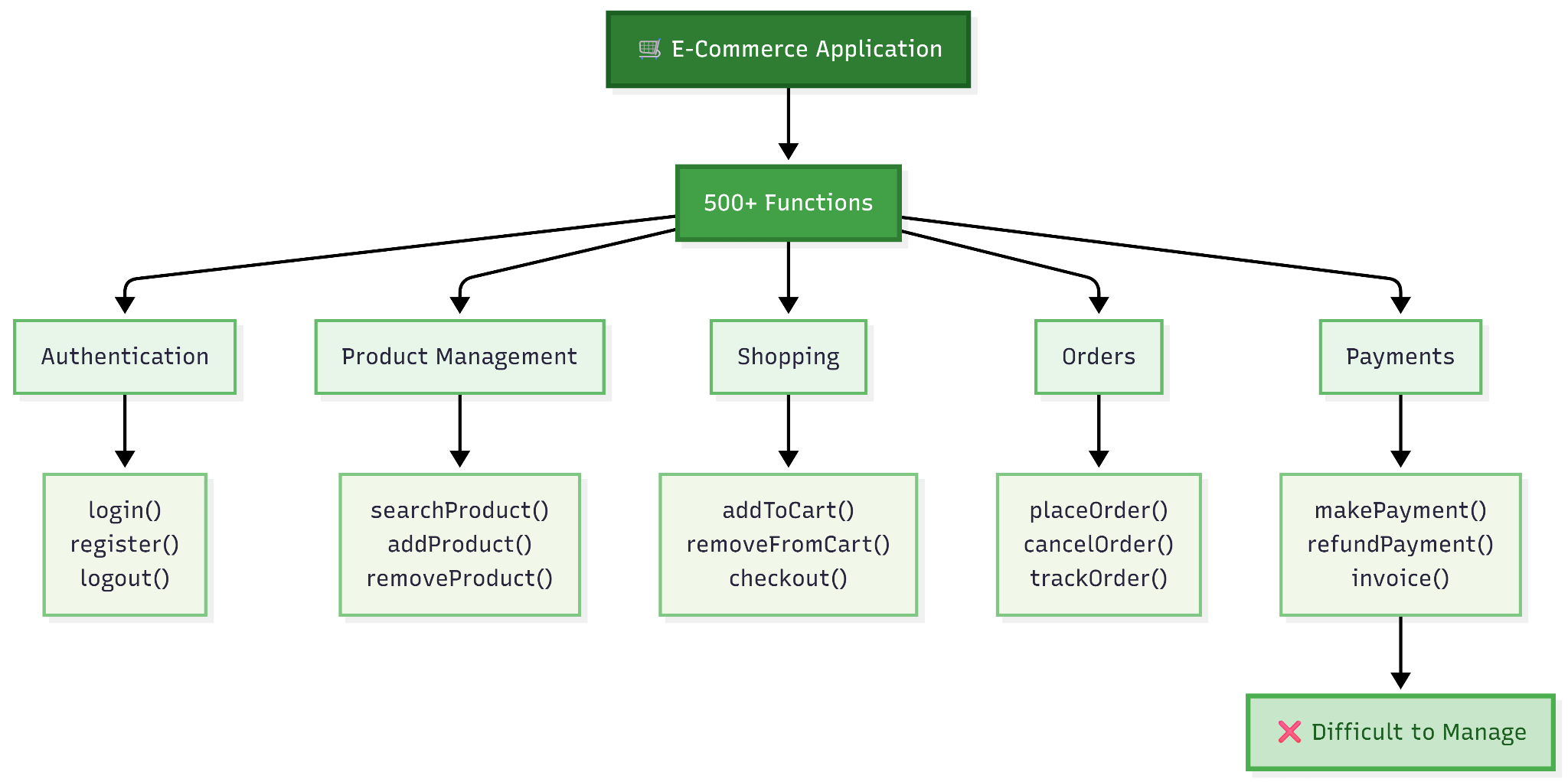
Without OOP Imagine you're building an E-Commerce Application. Initially, the project has only a few functions. As new features are added, the number of functions keeps increasing.
As the application grows, more and more functions are added. After a few years, the codebase may contain hundreds of functions. Developers spend more time searching for the correct function, fixing bugs, and understanding how different functions are connected. Adding a new feature becomes risky because changes in one function can accidentally affect others. Since multiple developers work on the same project, managing and maintaining the code becomes increasingly difficult. This results in poor readability, higher maintenance costs, and slower development.
With OOP
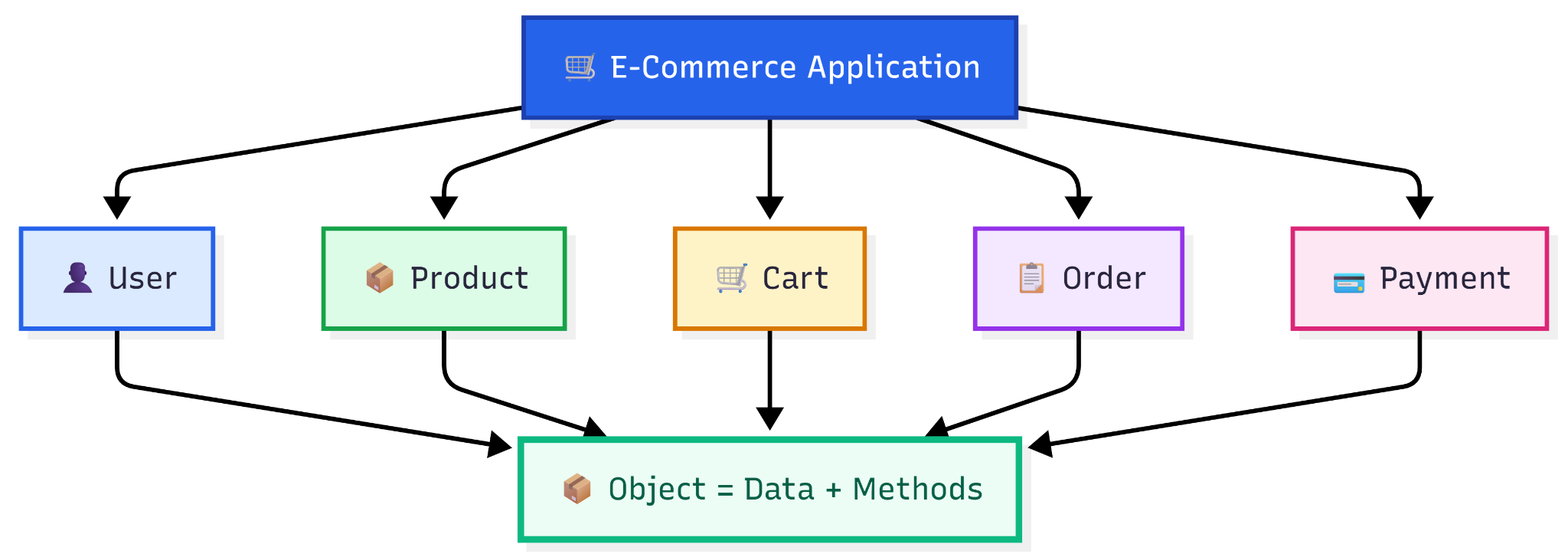
- Instead of placing everything inside one large collection of functions, OOP divides the application into well-organized classes.
Object-Oriented Programming organizes a large application into multiple classes, where each class is responsible for a specific feature. Every class contains its own data and methods, making the application modular, easy to understand, and simple to maintain. Instead of managing hundreds of unrelated functions, developers can focus on the class related to their feature, improving code organization and teamwork.
Why Companies Prefer OOP
♻️ Reusable A company creates a Payment class once. The same class can later be reused in an e-commerce application, a food delivery platform, or a ticket booking system, reducing development time and effort.
🔧 Maintainable Suppose the company introduces UPI payments. Developers only need to update the Payment class without affecting the rest of the application, making maintenance faster and safer.
📈 Scalable