OOP · Design Principles
Introduction to Design Principles
Reduces tight coupling between classes.
Benefits
- Reduces tight coupling between classes.
- Makes applications easier to extend.
- Improves unit testing through dependency injection.
- Encourages reusable and flexible components.
- Supports scalable and maintainable software architecture.
Best Practices
- Depend on interfaces or abstract classes instead of concrete classes.
- Inject dependencies through constructors or setters.
- Keep business logic independent of implementation details.
- Use dependency injection frameworks in large applications.
- Favor loose coupling throughout the application.
Common Mistakes
- Directly creating dependency objects using new.
- Making business classes depend on concrete implementations.
- Ignoring abstraction layers.
- Hard-coding service implementations.
- Confusing Dependency Inversion with Dependency Injection.
Introduction to Design Principles
Real-World Problem
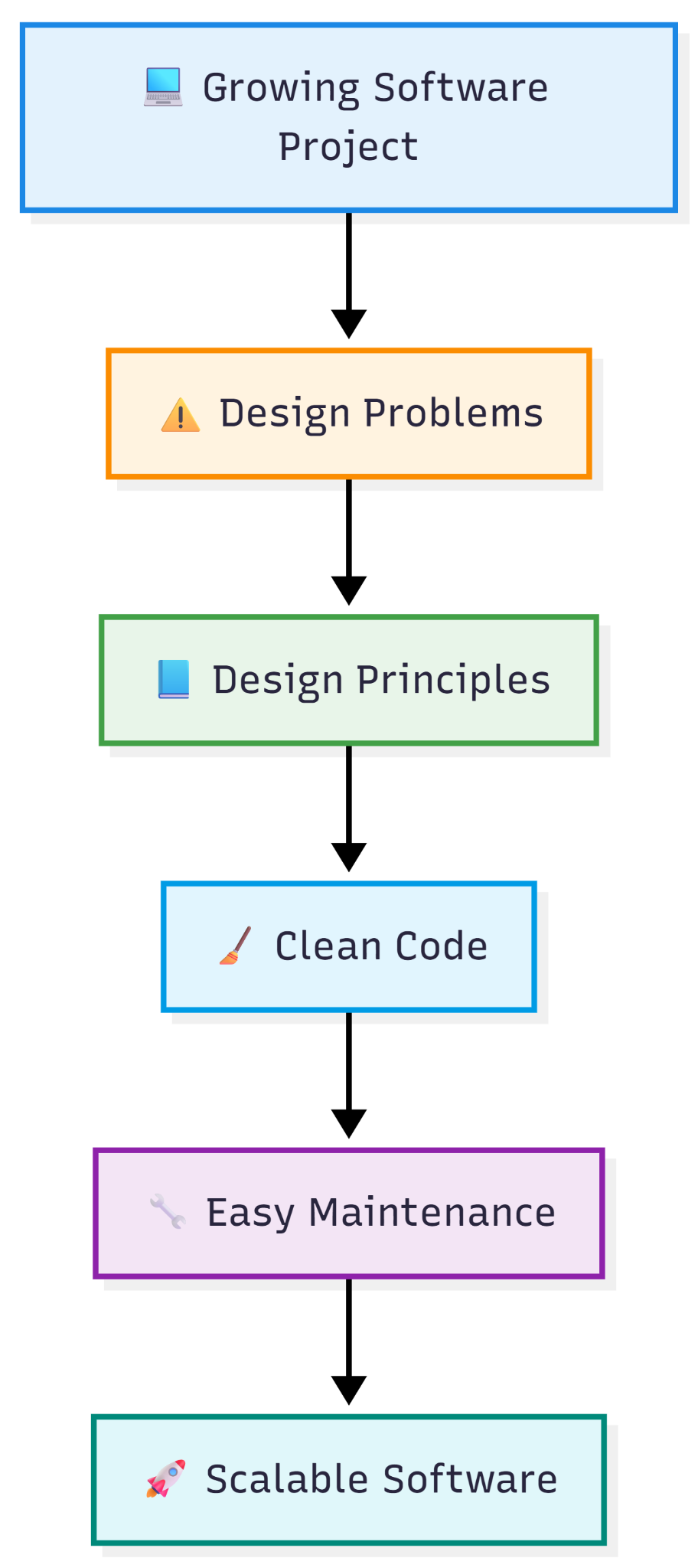
Imagine you're developing a Hospital Management System. Initially, only a few modules such as Patient, Doctor, and Appointment are developed. Since the project is small, developers write code quickly without following any design guidelines.
As the hospital grows, new features such as Billing, Pharmacy, Laboratory, Insurance, Online Consultation, Notifications, and Reports are added. Different developers solve similar problems in different ways. Some duplicate code, some create large classes, while others build unnecessary features for future requirements.
After several months, the application becomes difficult to maintain. Adding a small feature requires modifying many classes. Bugs become more frequent, code duplication increases, and developers spend more time fixing problems than building new features. What Are Design Principles?
Design Principles are a collection of best practices and guidelines that help developers design software that is clean, maintainable, reusable, and easy to understand. They provide a structured approach for organizing classes, methods, and modules so that applications remain flexible as they grow.
Unlike programming languages, Design Principles do not define syntax. Instead, they help developers make better design decisions while developing software. Who Introduced Design Principles?
Design Principles were not introduced by a single person or organization. They evolved over several decades through the contributions of many experienced software engineers and researchers.
Many of these principles were popularized by pioneers such as Robert C. Martin (Uncle Bob), Martin Fowler, Erich Gamma, Richard Helm, Ralph Johnson, and John Vlissides (Gang of Four). Their work on object-oriented design, clean code, refactoring, and software architecture established many of the principles that developers follow today.
Why Were Design Principles Introduced?
As software projects became larger and more complex, developers realized that poorly designed code was difficult to understand, modify, test, and maintain. The same mistakes—such as duplicated code, tightly coupled classes, unnecessary complexity, and poor organization—appeared repeatedly across different projects.
Design Principles were introduced to provide practical guidelines for avoiding these common problems. They encourage developers to build software that is easier to maintain, extend, and reuse while reducing development time and long-term maintenance costs. Why Do We Need Design Principles?
Modern software continuously evolves as business requirements change. New features are added, existing functionality is modified, and applications are expected to scale without becoming difficult to maintain.
Design Principles help developers organize code effectively by reducing duplication, minimizing dependencies, improving readability, and promoting reusable components. They also make collaboration easier because every developer follows the same design practices.
Without Design Principles, software often becomes difficult to understand, expensive to maintain, and more prone to bugs.
Benefits of Design Principles
- Improves code readability.
- Reduces code duplication.
- Makes software easier to maintain.
- Encourages reusable components.