OOP · Advanced OOP
Interface vs Abstract Class
Achieves complete abstraction.
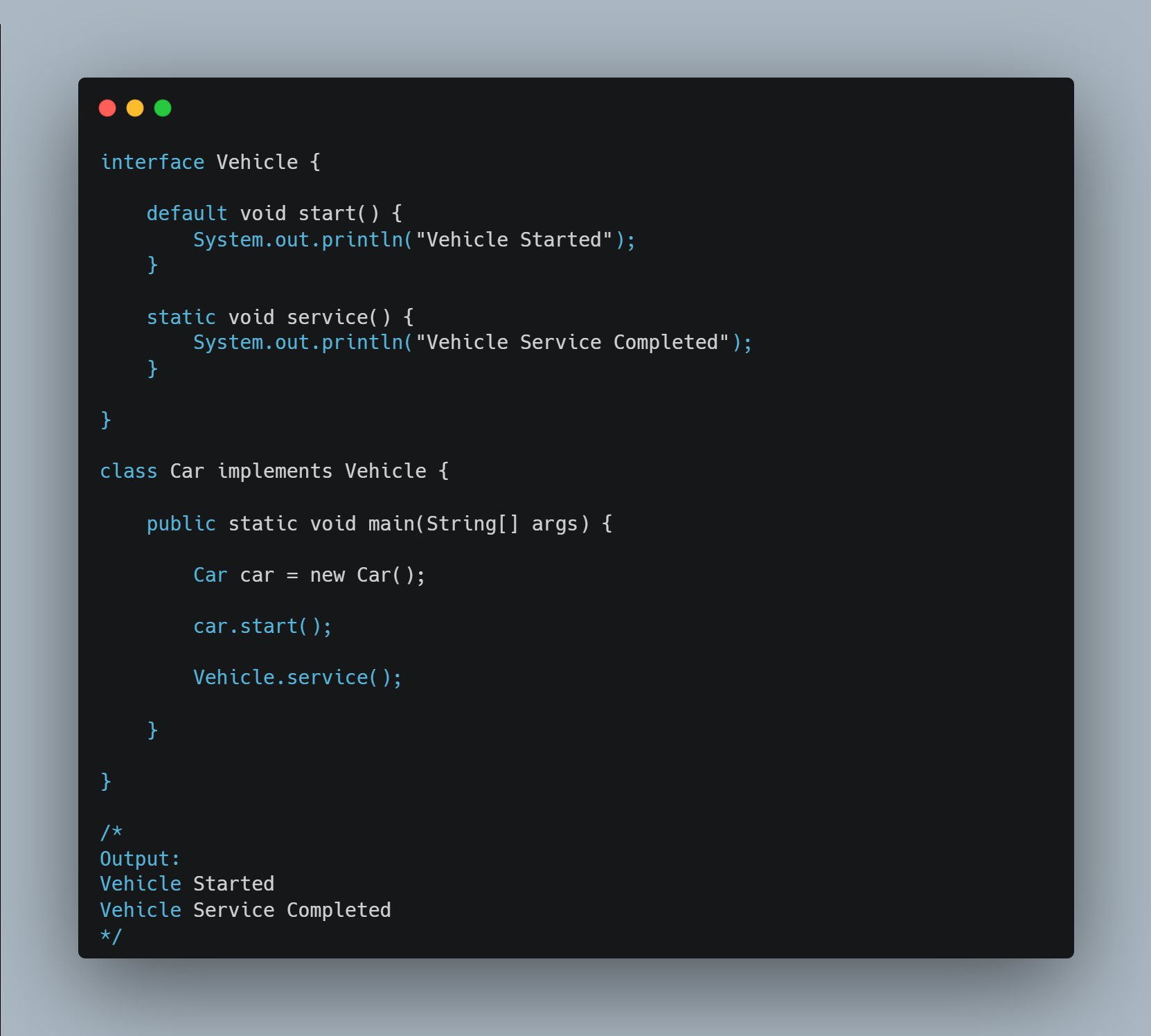
Default and Static Methods in Interface
Advantages
- Achieves complete abstraction.
- Supports multiple inheritance.
- Encourages loose coupling.
- Makes applications more flexible.
- Improves maintainability.
Imagine you're developing a Smart Home System. All smart devices have common information such as Brand, Model, and Power Rating, but they also support features like Wi-Fi and Bluetooth in different ways. Should you use an Abstract Class or an Interface? Choosing the correct approach leads to better software design. Why Compare Them?
Although both abstract classes and interfaces provide abstraction, they solve different problems. An abstract class is used when related classes share common implementation, while an interface is used when different classes only share common behavior. What are an Abstract Class and an Interface?
An Abstract Class is a partially implemented blueprint that allows code sharing among related classes. An Interface is a contract that defines behavior without providing implementation, allowing unrelated classes to follow the same standard.
When to Use an Abstract Class
- Shared code exists.
- Common variables are required.
- Constructors are needed.
- Classes have an "is-a" relationship.
When to Use an Interface
- Only behavior is common.
- Multiple inheritance is required.
- Loose coupling is preferred.
- Different classes implement the same functionality.
Abstract class = shared state + partial implementation (IS-A); interface = capability contract (CAN-DO).
// Abstract class: carries state and common code
abstract class Bird {
    String name;
    void breathe() { System.out.println(name + " breathes"); }
    abstract void move();
}

// Interface: a capability, multiply implementable
interface Flyer {
    void fly();
}

class Eagle extends Bird implements Flyer {
    void move() { fly(); }
    public void fly() { System.out.println(name + " soars"); }
}